

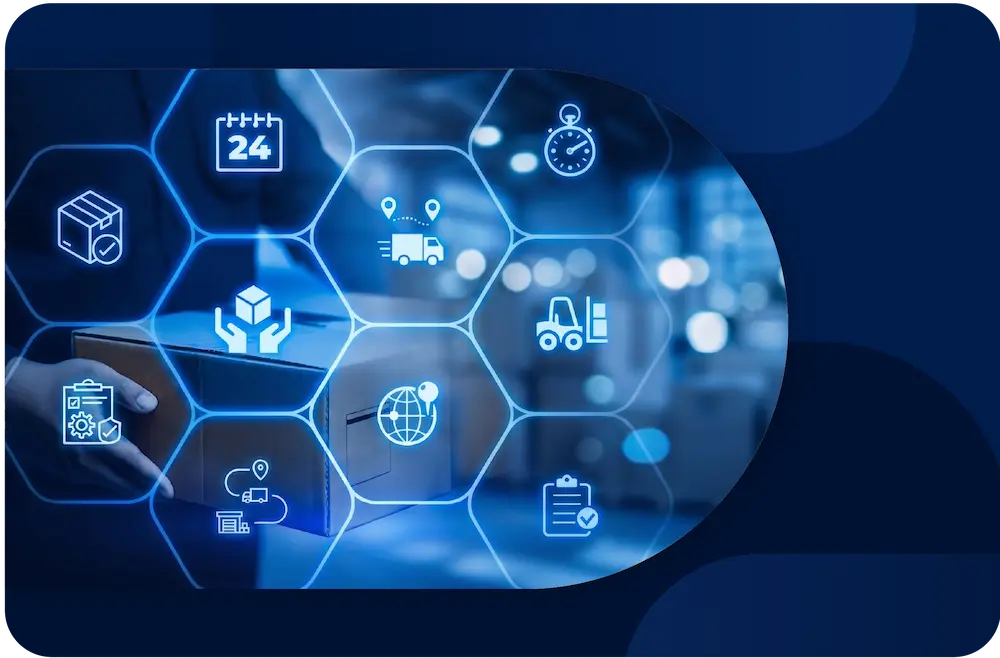
E-commerce fulfillment is the end-to-end logistics workflow spanning product receiving and storage through order processing, item picking, packaging, last-mile dispatch, and reverse logistics (returns). An efficient fulfillment model turns a customer's online purchase into a fast, accurate, and profitable delivery by connecting digital sales channels to physical inventory networks in real time.
Key stages of the e-commerce fulfillment process
The fulfillment lifecycle consists of a coordinated sequence of operational steps where every link dictates order cycle times:
- Inventory storage & management: Centralizing and tracking available stock across warehouses, distribution centers (fulfillment centers), or retail stores.
- Order capture & receiving: Automatically syncing incoming purchases from e-commerce platforms, marketplaces, or mobile apps against live stock.
- Intelligent node allocation: Selecting the most efficient fulfillment origin (central warehouse, dark store, or nearby retail location).
- Item picking: Physically retrieving items across the warehouse or store floor using optimized route navigation.
- Packing & conditioning: Predictive boxing, labeling, and securing parcels ready for carrier dispatch.
- Shipping & last-mile delivery: Transporting packages directly to customer addresses or click-and-collect pickup locations.
- Reverse logistics: Processing returns or exchanges and reintegrating items back into sellable inventory with complete traceability.
Most common e-commerce fulfillment models
Selecting the appropriate fulfillment framework depends on order volume, capital capacity, and the desired level of operational control:
In-house fulfillment
The business directly manages its own facilities, labor, and delivery operations. It provides complete control over the end-to-end customer experience but requires high initial capital investment in infrastructure and technology.
Third-party logistics (3PL)
An external logistics partner handles warehousing, pick-and-pack, and carrier shipping. This minimizes fixed capital expenditure and fixed overhead in exchange for reduced direct control over daily operations.
Dropshipping
The merchant sells products without holding physical inventory; the supplier or manufacturer ships orders directly to end customers. It eliminates inventory holding risk but limits control over packaging quality and shipping speeds.
Marketplace fulfillment
An e-commerce marketplace stores, prepares, and ships orders on behalf of third-party sellers for a fee. It simplifies platform scaling but can fragment broader inventory control.
Distributed fulfillment
Routes each incoming order to the optimal network node (central warehouse, regional hub, dark store, or physical retail store) via real-time orchestration. This model enables physical stores to operate as decentralized micro-fulfillment hubs (ship-from-store).
In-house vs. 3PL fulfillment: key differences
Comparing cost structures and operational control helps determine the optimal fulfillment setup:
| Operational Aspect | In-House Fulfillment | Third-Party Logistics (3PL) |
|---|---|---|
| Upfront Investment | High (facilities, software, labor). | Low or zero: Variable pay-as-you-go model. |
| Process Control | Total: Complete oversight of every stage. | Partial, subject to third-party SLAs and terms. |
| Scalability Speed | Requires capital expenditure and planning time. | Fast: Leverages existing third-party networks. |
| Unboxing Personalization | High: Fully customizable brand packaging. | Limited to standard 3PL packaging options. |
Neither model is inherently superior; the right choice depends on profit margins, daily order volume, and how central delivery experience is to your brand strategy.
Criteria for choosing your ideal fulfillment model
To select the right fulfillment architecture for your business, evaluate the following operational factors:
- Order volume: Low or highly seasonal volumes often favor flexible 3PL setups; sustained high volumes justify investing in in-house or distributed infrastructure.
- Customer experience control: If unboxing presentation and delivery speed are key competitive differentiators, in-house or distributed fulfillment provides greater flexibility.
- Multi-channel sales strategy: As you add sales channels, operating from a single, unified inventory source across all touchpoints becomes essential.
- Existing physical store network: Retailers with brick-and-mortar footprints can adopt distributed fulfillment to transform stores into regional dispatch hubs (ship-from-store).
- Capital expenditure capacity (CapEx): Weighing upfront capital availability for facility equipment and technology against a preference for variable operating costs.
Why fulfillment is critical in omnichannel retail
In an omnichannel sales strategy, fulfillment evolves from an isolated channel task into a unified network decision: determining which node fulfills every order, with what live inventory pool, and at the lowest cost.
Uncoordinated fulfillment across channels results in stockouts, dispatch delays, and unnecessary shipping expenses. Synchronizing all fulfillment nodes under an intelligent operational layer turns fulfillment into a profitable competitive advantage.
Frequently asked questions
What are the most common e-commerce fulfillment models?
The most common models are in-house fulfillment, outsourced third-party logistics (3PL), dropshipping, marketplace fulfillment, and distributed fulfillment—which routes each order from the most efficient network node rather than relying solely on a single central warehouse.
What is the difference between in-house and 3PL fulfillment?
In-house fulfillment means the business directly manages its own warehouses, staff, and delivery fleets, offering maximum control at a higher initial capital investment. 3PL fulfillment delegates storage, picking, and shipping to an external logistics provider, lowering capital expenditure but offering less direct process control.
How do I choose the right fulfillment model for my business?
Evaluate your order volume, desired level of control over the customer delivery experience, total number of active sales channels, availability of physical retail stores that can serve as dispatch hubs, and available capital expenditure for software and infrastructure.
Continue exploring omnichannel fulfillment with Janis Commerce
Fulfillment is where real-time inventory synchronization and intelligent order orchestration deliver maximum ROI. Built on a composable architecture, Janis Commerce empowers enterprise retailers to integrate warehouses, dark stores, and retail locations into a single, unified distributed fulfillment operation.
Learn more about Janis Commerce
.jpg)


