

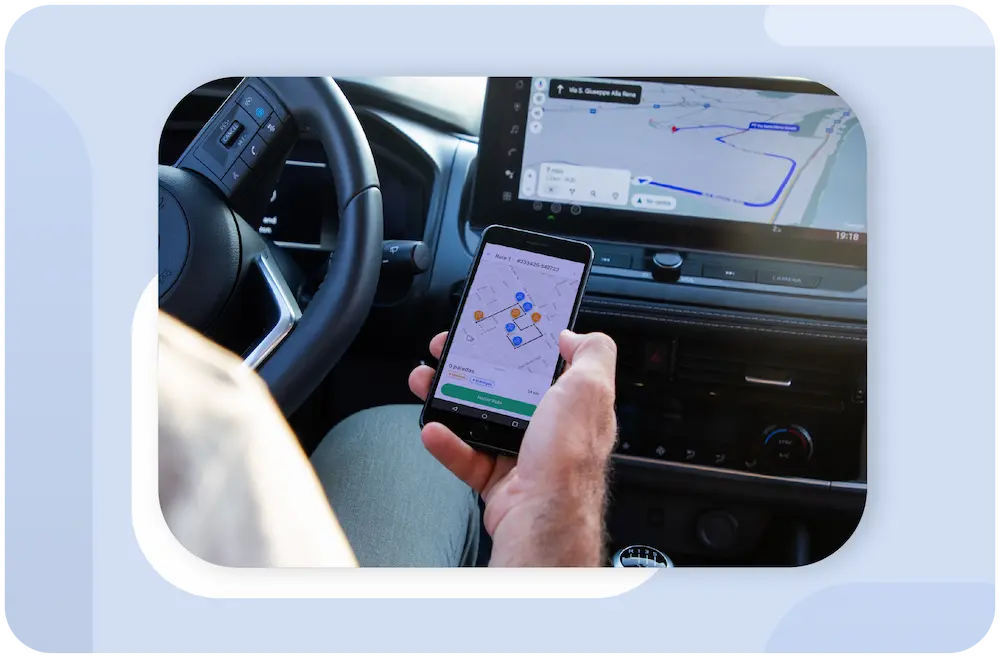
Optimizing e-commerce logistics means systematically structuring the six key pillars of omnichannel fulfillment: real-time inventory visibility, intelligent order orchestration, warehouse and store picking, packaging efficiency, last-mile delivery, and real-time KPI tracking. When any single link breaks, it drags down the entire supply chain: outdated stock leads to misallocated orders and cancellations, while unoptimized routing results in missed delivery windows and escalating costs.
How to optimize your e-commerce logistics step by step
To transform your digital supply chain into a scalable, highly profitable operation, execution must be aligned across these strategic steps:
Step 1: Real-time inventory visibility
Before optimizing any downstream fulfillment step, you need complete accuracy regarding stock quantities and locations across every warehouse, retail store, and dark store. Without this foundation, every subsequent decision—from routing origin to picking paths—relies on stale data. Real-time inventory synchronization is the mandatory baseline for omnichannel operations.
Step 2: Intelligent order orchestration
With real-time stock control established, the next priority is deciding which network node should fulfill each order. This is orchestrated by a Distributed Order Management (DOM) engine: evaluating live stock availability, customer proximity, node operational capacity, and shipping costs simultaneously to assign orders to the optimal fulfillment origin—or split items across nodes when necessary.
Step 3: Optimized picking and fulfillment
Once an order is assigned, operational bottlenecks frequently occur on the warehouse or store floor due to long walking distances, rigid layouts, and manual task assignment. Implementing batch picking for similar items, generating AI-driven pick paths based on historical movement patterns, and dynamically balancing picking capacity with carrier cutoff times dramatically reduces picker travel time.
Step 4: Packaging and volumetric optimization
While packaging is often overlooked, it directly impacts profit margins. Predictively sizing carton and container requirements for each item mix—and maximizing volumetric space utilization across totes and delivery vehicles—minimizes wasted dimensional space, driving down storage and freight expenditures.
Step 5: Last-mile delivery and dynamic routing
The last mile represents a significant percentage of total e-commerce logistics costs. Optimizing this stage requires real-time dynamic route planning—accounting for traffic, weather, and shipment volume—while automatically dispatching orders to the most cost-effective carrier. Supporting flexible delivery options (click-and-collect, scheduled slots, or express delivery) without missing SLA promises maintains customer satisfaction at scale.
Step 6: Real-time KPI tracking
Continuous improvement requires actionable operational data. Deploying real-time management dashboards—rather than relying on manual, end-of-month reporting—enables operations leaders to identify friction points and resolve bottlenecks before they impact the end customer.
The main bottlenecks in e-commerce logistics
Identifying operational friction early prevents service degradation and runaway fulfillment costs:
Outdated inventory levels
System records drift out of sync with physical stock on store or warehouse shelves, driving overselling, backorders, and customer friction.
Static, rule-based order routing
Orders default to central warehouses regardless of customer proximity or actual shipping costs from nearby retail stores.
Inefficient picking paths
Store associates and warehouse staff waste hours traversing unoptimized routes without automated batching or sequence logic.
Unstandardized packaging
Excessive box sizes and poor volumetric fill increase dimensional weight charges and inflate transport costs unnecessarily.
Static last-mile routing
Fixed delivery schedules cause late shipments, poor fleet utilization, and high freight costs by ignoring daily operational variables.
How to reduce cost-per-order in omnichannel operations
Cost-per-order drops significantly when fulfillment is addressed holistically rather than in isolated operational silos:
- Unified inventory prevents overstocking and out-of-stock cancellations.
- Real-time order orchestration consistently selects the lowest-cost fulfillment path.
- Optimized picking lowers labor hours required per item prepared.
- Intelligent last-mile routing decreases transportation costs per delivery.
Enterprise retailers across the region operating on Janis Commerce's Composable Platform—such as Walmart, Carrefour, and Chedraui—achieve up to a 50% reduction in operational costs.
Essential KPIs for e-commerce logistics optimization
To maintain complete control over the financial and operational health of your fulfillment network, track these core metrics in real time:
| Logistics KPI | Definition | Operational Impact |
|---|---|---|
| Fill Rate | Percentage of customer orders fulfilled completely on the first attempt. | Ensures full order delivery without missing inventory items. |
| On-Time Delivery (OTD) | Percentage of orders delivered within the promised SLA window. | Measures compliance with promised customer delivery windows. |
| Cancellation Rate | Proportion of orders canceled due to stockouts or fulfillment failures. | Protects customer trust and prevents NPS degradation. |
| Picking Productivity | Units picked and prepped per hour per store associate or operator. | Maximizes throughput capacity within warehouses and stores. |
| Cost-Per-Order (CPO) | Average total operational cost to process, pick, pack, and ship an order. | Summarizes the overall financial efficiency of the supply chain. |
Frequently asked questions
What are the main bottlenecks in e-commerce logistics?
The most common bottlenecks include outdated inventory levels, rigid rule-based order routing instead of real-time decisions, poorly designed picking routes, inefficient packaging, and unoptimized last-mile delivery.
How can you reduce cost-per-order in omnichannel operations?
By holistically addressing inventory, order routing, picking, packaging, and last-mile logistics together rather than optimizing isolated silos. Enterprises centralizing these workflows on a unified platform reduce operational costs by up to 50%.
Which KPIs should you measure to improve e-commerce logistics?
At a minimum, monitor Fill Rate, On-Time Delivery (OTD), Order Cancellation Rate, Picking Productivity, and Cost-Per-Order using real-time dashboards rather than end-of-month static reports.
Streamline your e-commerce logistics with Janis Commerce
Janis Commerce centralizes inventory management, order orchestration, store/warehouse picking, packaging, last-mile routing, and efficiency dashboards into a single composable platform. Discover how to reduce pick times by up to 30% and scale your fulfillment operations end-to-end.
Request a demo
.jpg)


